Monday, 4 August 2025

Those infrared contact lenses

I think it's about time I wrote about this story, as it has made the newspapers, including a good piece in the Guardian.

Basically, this follows on from something I have noted before, back in March 2019, whereby Chinese and American researchers extended the range of rodent vision by injecting nanoparticles into their eyes. Now, a team including some of the original researchers have put the nanoparticles into contact lenses which can achieve a similar effect in humans, who can report on their experience better than the mice.

I think it's important to note that the nanoparticles absorb photons with wavelengths in the range 800 to 1600 nm (a little more than the range of IR film or digital sensors) and emit it in the range 400 to 700 (visible light), mostly around 550 and 650. So this is not thermal imaging and it won't enable you to see in the dark (without suitable IR illumination). Also, because the partlcles absorb and then emit, two things happen. One is that the upconversion takes some energy, so the intensity will be reduced. The other is that this doesn't appear likely to give you a sharp image but whether the result looks like the old HIE halation or is basically foggy isn't clear. My guess is the latter. So you could detect an IR source but it wouldn't look like an IR photograph. However, the team say that using their material in glasses makes things sharper, so I may be misunderstanding the process.

Another bonus, which the news coverage picked up on, is that the IR passes easily through thin skin, such as your eyelids, so you can see the results even with your eyes closed.

Different input wavelengths can be shifted to different output wavelengths. This isn't like colour infrared film but is actually more interesting and nuanced, with the examples reported by the Guardian being 980nm shifted to blue, 808nm to green and 1532nm to red.

I look forward to finding out more.

[Original paper: www.cell.com/cell/abstract/S0092-8674(25)00454-4]

Monday, 3 March 2025

Travel Photographer of the Year shoots Infrared

Infrared photo of a lion striding out across landscape in Africa

The recently announced awards for Travel Photographer of the Year drew my attention because the winning images are infrared photographs by American photographer Piper Mackay. Piper lives in Kenya and has been photographically exploring the wilds of Africa since 2004. Her work has appeared widely, including National Geographic.

The award web page is at www.tpoty.com/tpoty-winners-galleries/2024-winners and there are further examples of wildlife shots on her own web site at www.pipermackayphotography.com/2016/08/africa-in-infrared. She discusses the award on her own blog. Some great images here, whatever the wavelengths.

I emailed Piper to ask what equipment she used and she tells me that she mostly uses a Nikon Z7 converted with a 720 nm filter for her infrared work, which includes both landscape/wildlife shots as well as portraits of local tribespeople.

So, a hearty Infrared 100 congratulations.

[Updated to include photo (courtesy of Piper) and more information from Piper.]

Sunday, 24 November 2024

Tidy IR solution for mirrorless cameras

Kolari Vision have been busy. They have introduced a behind-the-lens clip-in system for filtering which allows you to swap filters directly in front of the sensor. This is especially useful for lenses which don't allow you to put a fiter in front of the lens, such as fish-eyes. Of course some lenses have special filter slots built-in but these are inherently restricted.

I had wondered whether a full-spectrum converted mirrorless camera would revert to conventional visible light work by putting an infrared-blocking filter (aka 'hot mirror') in front of the sensor/lens. After all, unlike an SLR, the exposure sensing is done from the main sensor, not from a separate system, so it will still function as normal if the 'hot mirror' has the same characteristic as the original.

It turns out that Kolari have come to the same conclusion. If you have a mirrorless camera converted for full-spectrum photography, such as a Nikon Z series, you can then add a suitable 'hot mirror' flter in front of the sensor simply by clicking it into the Kolari magnetic filter system. In that case, your camera is 'conventional' again.

One important thing to bear in mind is that if you buy a new camera and have it converted (by any facility, not just Kolari) you will probably invalidate the original warranty. So best to wait a bit.

So, two links to explore: Kolari's clip-in filters and hot mirror replacement (here as an external filter).

And while you're there, Kolari have a fascinating article about the dreaded infrared hotspots, which answers quite a few questions!

Wednesday, 10 July 2024

Kolari Vision Infrared Competition

The American infrared specialists, Kolari Vision, based in New Jersey, are running their infrared photography competition In Another Light again this year.

The competition runs until the end of October 2024, with winners notified by mid-December and is open to individuals world-wide (apart from a few places) with a range of categories and prizes. Check out the In Another Light web page for more information.

Entry is free and I'm glad to see that Kolari state that copyright in submitted images remains with the photographer. The prizes are vouchers for Kolari's goods and services, which includes infrared conversions, filters and ready-made near-infrared cameras.

Sunday, 7 April 2024

Dune movie scenes shot in Near Infrared

One of the big cinematic releases at the moment is the second part of Denis Villeneuve‘s interpretation of Frank Herbert's SF Epic Dune.

Cinematographer Greig Fraser decided to use near-infrared (NIR) imaging to show the weird environment of the planet occupied by the film's uber-villains, the Harkonnens. He had used the technique before, on Zero Dark Thirty in 2012 and Rogue One: A Star Wars Story in 2016.

While the Australian movie BRINDABELLAS | edge of light in 2016 (see below) had used RED cameras configured for monochrome IR, Dune used an ARI Alexa camera but the basic premise is the same. The usual infrared blocking filter was removed and replaced with a 'black' infrared-pass filter.

The idea with Dune was to show the unreal environment the Harkonnen's inhabited. The first film had only shown interiors but the second part required exterior shots. One significant result of this technique is the surreal look of the characters, since NIR penetrates a few millimetres into skin (and the characters are hairless) and there is the well-known look of people's eyes and the inherent high contrast.

[Photo: Dune: Part Two Infrared Copyright © 2022 Warner Bros. Pictures, Inc.]

I can point you to the following for much more information: Variety, NoFilmSchool, Kolari and ARRI Rental.

This provides an opportunity to review some of the history of near infrared in feature films.

Infrared film was a useful tool in the motion picture industry as far back as the 1920s. Kodak had produced their first infrared ciné film stock in 1925 and by 1937 it was also available from Agfa and DuPont. Agfa's was the first of what was described as the modern infrared film in that it was not a panchromatic emulsion pushed into infrared sensitivity. The new films were only sensitive to UV and blue and then to extreme red and infrared. This simplified the filter needed and a Wratten #29 (deep red) was the most common used. Sometimes infrared film was used in the making of travelling mattes (used to replace backgrounds in shots) but more often it was used in black and white movies to allow night-time scenes to be shot during the day, a technique now known as 'day-for-night'.

Not all the artefacts of infrared images were welcome however, and special makeup (usually lipstick) and set painting often had to be applied. Sometimes foliage was sprayed with green paint to hide the Wood effect and prevent shifts in tone. Paramount even painted an entire back-lot 'Brownstone Street' in special blue-grey paint called infra-red blue so that it would look the same on both infrared and panchromatic stock. The 1941 DuPont film was welcomed by cinematographers because of its lack of Wood effect and the three apparently competing emulsions had actually found slightly different and complementary niches in this specialised application.

By the 1960s the movie industry was moving from black and white to colour and infrared's abilities for day-for-night shooting were obsolete. But occasionally infrared filming was used for artistic effect.

In the early 1960s there was a curious collaboration between the Cuban and Russian film industries resulting in an extraordinary movie called Soy Cuba (I am Cuba). The director was Mikhail Kalatozov, famous most probably for The Cranes Are Flying in 1957, and the director of photography was Sergey Urusevsky. The film is a cinematic tour de force, featuring several long single-take sequences which almost defy attempts to work out just how they were done.

Much of Soy Cuba was shot using infrared film, with characteristic bright foliage and dark skies. The film stock was actually manufactured for use by the Soviet military, so it was quite a coup for the production to access some of it.

More recently, movie-maker Mike Figgis has been experimenting with low light and infrared photography using consumer video cameras with Sony's Night Shot facility. His 2001 film Hotel includes scenes done this way, to such an extent that the actors in the scenes could not actually see each other during filming.

The director of 2006 movie Wristcutters (A Love Story), Goran Dukic, had intended to use Kodak Ektachrome Infrared extensively to provide the look of the film's afterlife for suicides setting. Kodak provided unique super-16 format stock for this purpose, but after shooting some tests Dukic decided to use post-production techniques rather than infrared film. Some of the test sequences were shown on the film web site and on the published DVD. The production eventually sold off their unique stock for $300 per roll.

In 2015 film makers Glen Ryan and James van der Moezel of silver dory productions in Australia released a movie to exploit the monochrome infrared abilities of the RED digital cinema camera, called BRINDABELLAS | edge of light. It was described as “the World’s first near-infrared feature” and was shot in 4k resolution. I wrote it up in a blog post at the time, and the movie is still available on their web site.

Since most NIR-converted stills cameras can now shoot movies as well, the scope for infrared movies has expanded greatly over the past century.

Wednesday, 27 March 2024

Simon Marsden: Online exhibition and print sale

I'm delighted to have been pointed to a new online exhibition from the Centre for British Photography of infrared photographs by the legendary Simon Marsden ... subtitled Visions of a Ghost Hunter.

Here it is: britishphotography.org/exhibitions/70-simon-marsden-visions-of-a-ghost-hunter

The exhibition is online starting yesterday (March 26th) and running until April 26th 2024. There are 23 photographs of his characteristic ruins and landscapes, all exploiting the idiosyncratic style of Kodak's much-missed 35mm High Speed Infrared film.

Sadly, the £1500 price tag is too much for me but these are wonderful images and well worth a view.

The show is online because the Centre for British Photography have now closed their gallery in central London as the lease ended early; but this was apparently only ever intended to be a temporary space. Follow their web site for updates.

Sunday, 24 March 2024

Ed Thompson Infrared Story

Back in September 2016 I wrote about a colour infrared project by documentary photographer Edward Thompson called The Unseen.

Ed has been building up a YouTube channel called Pictures On My Mind and this includes some explanations of the work he did with some of the last remaining stock of infrared Aerochrome, which was basically the same as infrared Ektachrome EIR.

The latest video outlines at length the shooting he did in Pripyat, Chernobyl, and included in The Unseen. This part of his infrared journey started with finding out that false-colour infrared film was widely used in forestry. The normal red look of healthy foliage would tend towards magenta when the foliage was 'stressed' and it was a good way of determining forest health from a distance.

Alongside the Chernobyl video is another one going into more detail about other parts of the Unseen project, but because it includes some nudes (to demonstrate IR's ability to allow you to see a few millimetres under the skin and to echo demonstration shots published by Kodak) this video is restricted and Ed has had difficuly making the most of his whole channel.

This video passes on a couple of interesting pieces of information about Ed's technique. One is that, certainly until he was totally au fait with the idiosyncratic film, Ed bracketed the shots. I always found this was essential for any infrared film but I have come across photographers who are able to get it spot on without bracketing. The other is that he says in the video that he used a visually-opaque R72 filter to get the very deep reds that he achieved. Usually you'd use a minus-blue filter (yellow) with EIR. Those reds are mind-blowing!

Each section of The Unseen represents different applications of infrared photography with others including art investigation and restoration and medical imaging. (In fact the third edition of the standard text, Photography by Infrared, was written by Lou Gibson, who was a pioneer of medical photography.)

So I can recommend Ed's YouTube channel and especially The Red Forest of Pripyat Chernobyl. Enjoy!

Thursday, 8 February 2024

Uranus is not as boring as we thought

The conventional view of Uranus has been that its apparent surface shows few, if any, distinguishing features. The images from the Voyager 2 probe in the 1980s showed what Nasa describes as a "placid, solid blue ball".

The James Webb telescope, using infrared wavelengths rather than Voyager's visible ones, shows something else. In this light the north polar ice cap becomes visible. (Uranus, bizarrely, rotates almost at right angles to all the other planets so the north pole is, in this configuration, pointing towards us.) Some storm clouds are apparent as well, and the planet's rings show up clearly.

I've not been adding to this blog of late, so I realise I am a bit late with this as a group of photos were released by Nasa back in December 2023. The Nasa web page has copious information about the set, which includes wider field photographs (also larger than the image above).

That Nasa page doesn't give information about the wavelengths used for the image. There's a more detailed report from Scientific American, which notes that image is built using wavelengths of 1.4, 2.1, 3.0 and 4.6 microns. Since photographically, we're more used to nanometres this means 1400, 2100, 3000 and 4600 nm.

[Image credit: NASA, ESA, CSA, STScI]

Monday, 14 August 2023

Thermal images of sun-baked Phoenix Arizona

The Guardian recently published a photo set matching far infrared images of Phoenix with ordinary photographs.

The images were taken by Carlos Barria, using a Flir thermal camera, which also shows a point temperature (in Fahrenheit).

It's an interesting set, taken in late July 2023 and which "reveal a Phoenix where concrete on the street registers 150F (66C), outdoor workers’ bodies reach 105F (41C) and homeless people swelter, surrounded by surfaces as hot as 143F (62C)" and it's unusual to see visual and thermal images matched in this way: you can swipe between the two.

The link is here: Thermal images of the US heatwave in Phoenix, Arizona

Monday, 10 July 2023

Infrared generative AI

I've been 'playing around' with a couple of generative artificial intelligence engines that carry out text-to-image. I was interested in how they understood the look of an infrared photograph.

This was partly because I find that at least one of my IR photos has found its way into the models used for generative AI. Without permission of course!

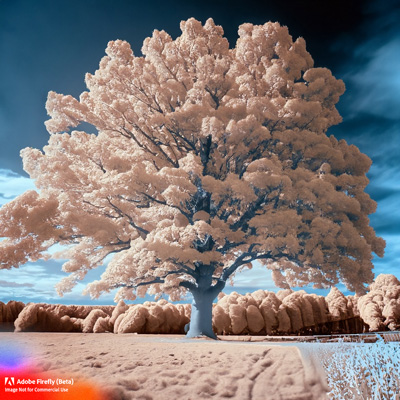
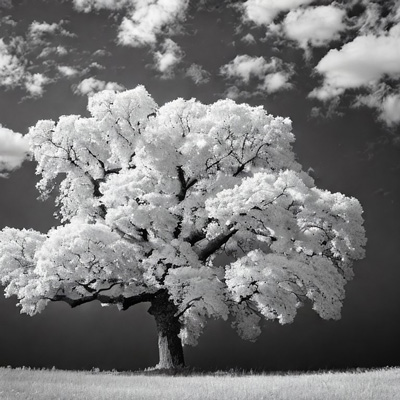
I tried a fairly simple shot; that of a tree. A good test for the basic Wood Effect. The results are quite good and, given how unreal IR photos can look anyway, it would be difficult to tell from the real thing. Sometimes the background detail gives things away but I found I could quickly get good results.

The two I tried are Stable Diffusion and Adobe Firefly (chosen simply because I have access to them) and the text prompt is the same for each: Infrared image of an oak tree in a meadow.

This is the Firefly result ...

As you can see, I got a false colour image without specifying, and in this case it's not a bad result. Often the system would put arbitrary colour washes over the image, but here the result is as you'd expect.

This is the Stable Diffusion result ...

Here, it's black & white straight away. Again, a pretty good result.

I did also try to generate some thermal images but neither engine could get anywhere near what you'd expect, presumably because there are not many, if any, thermal images in the training set.

Sunday, 11 June 2023

James Jarché Infrared

I've mentioned in a previous post that the famous press photographer, James Jarché, had experimented with infrared photography in the early 1930s. I also noted that he had used IR to document the photographic manufacturing process for Ilford.

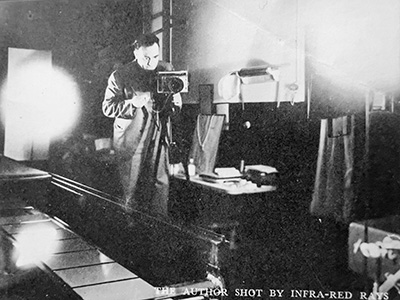
I recently managed to buy a copy of his memoir, People I Have Shot, and this includes some plates. One of them was taken by an unknown Ilford employee showing Jarché taking one of the photographs at Ilford's factory.

Here it is, captioned The Author Shot by Infra-red Rays.

Although in darkness, here you can see Jarché with his camera on a tripod, pointing a little to the right of the viewpoint.

Sunday, 12 March 2023

Barnaby Attwell infrareds in Falmouth exhibition

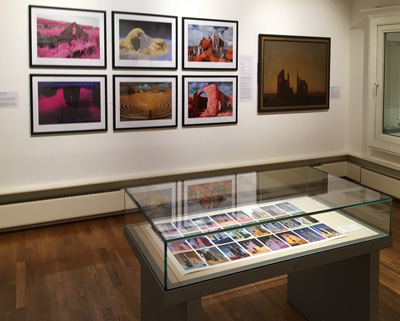
Having recently discovered Barnaby Atwell's faux-colour infrared shots of Cornish landscapes I was delighted to find that he has some included in a new seasonal exhibition in Falmouth.

The exhibition is called Unfamiliar Territory and is on at the Falmouth Art Gallery until June 1st.

The exhibition press release describes the event ...

Unfamiliar Territory is a stunning new exhibition opening this February at Falmouth Art Gallery that will explore a range of themes linked to the Cornish landscape. It brings together an exciting selection of 20th and 21st century artists who have been inspired by Cornwall’s diverse landscapes to create works that show it in innovative ways and explores how Cornwall’s iconic landscapes have evolved over the years.
The exhibition runs from the 11th February to 1st June 2023 and will feature nationally renowned artists such as: John Tunnard, Wilhelmina Barns-Graham, Kurt Jackson, Danny Markey, Tom Cross, Patrick Heron, Albert Reuss, Bryan Wynter and more.

... and Barnaby adds that the gallery shop will be selling copies of his excellent book, Welcome to St Decay, as well as prints and postcards.

The web site for the exhibition is at www.falmouthartgallery.com/Exhibitions/2023/1846~Unfamiliar_Territory and Barnaby's blog post about it is at www.barnflakes.com/blog/unfamiliar-territory-press-release-and-private-view.

[Photo courtesy of Barnaby Atwell]

Wednesday, 8 February 2023

Second Band volume coming from Elliott Landy

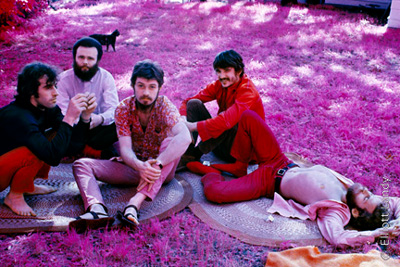
Almost exactly nine years ago I wrote about Elliott Landy's Kickstarter project to produce a book of his photographs of The Band, that bunch of Candian musicans who also,famously, backed Bob Dylan for a while. [Read the original post.]

That volume contained 200 photos chosen from the thousands that Elliott shot while in their company. Choosing a set is a difficult task, and lots of great shots are always left behind. So he has decided that it's time for a Volume Two! And he makes these pages because Elliott Landy included infrared film in his toolkit and, just as there were some IR shots in the first book, there will be some infrared images in the new one; shot using 35mm Infrared Ektachrome.

Here's one of the infrared images from the first book to whet your appetite ...

You should visit the Kickstarter page of course, and decide whether you want to join in.

Monday, 6 February 2023

A few Infrared Photographers

It's always nice to come across other photographers who either specialise in infrared or who take the odd very good shot. So here are a few:

Kate Ballis is based in Melbourne and has a neat line in faux-colour digital images. As her online biog says "In her Infra Realism series, Kate creates unique, colour-drenched images using infrared technology." She took an IR-converted camera and experimented with filters to produce dramatic images.

Also doing interesting things with digital colour is Barnaby Attwell ... aka Barnflakes. He's based in Cornwall and published a thin volume of colour infrareds of Conrnish landscapes. His palette is different to Kate's, which demonstrates the variety of results you can get with digital infrared. I also added his book to the Invisible Light Bibliography.

More 'conventional' digital mono infrareds can be found with Pauline Rook. I came across her photographs in a craft gallery in Wells and find that her aesthetic is similar to mine (though I think her eye is better). Her web site, includes IR images shot in Africa as well as closer to home.

A final single image from Richard Mosse. Lately he's been shooting with thermal cameras but I was interested to come across a single shot of his in The Guardian newspaper recently. It's called The Amazon’s highway through hell (I think) and, very unusually, was shot using an 8 by 10 inch sheet of the legendary Kodak HIE film. To quote Oliver Cromwell, you can see the image 'warts and all' on the page but it's a great shot.

Wednesday, 7 December 2022

More Near-IR cameras from FujiFilm

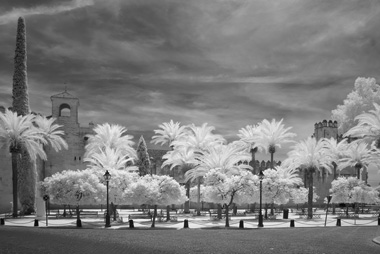
For a while I have used a near-infrared camera made by FujiFilm called the FinePix IS Pro. This is based on the FinePix S5 Pro, which is in turn based on the Nikon D200 which, for me was useful as I have some Nikkor lenses that fit. (Recently I have been using a converted compact camera, simply because it is convenient, but the Fuji is more versatile. An example shot from Cordoba is above.) It has no blocking filter so you can use any filter combination you want and in my case that included a yellow filter for false-colour IR tests (not 100% satisfactory) and trying a variety of filtration methods. [See this blog post on the subject.]

I had thought that this camera was an experiment that Fuji wouldn't repest but it turns out I was wrong as I came across their X-T1 IR camera. This was first introduced in August 2015, which shows how on the ball I was, or how secretive Fuju are about this device. At 16 megapixels it isn't really up to current specs of course but, based on their web site, it is currently available. Fuji are marketing it carefully to "technical experts, law enforcement, medical research and scientific communities" and I would assume the EULA places restrictions on use as with the IS Pro. In theory the usage can include Fine Art.

So this isn't enough to make me want one, but it does indicate that there is a small market for out-of-the-box IR cameras as well as conversions.

The FujiFIlm web page for this camera is at www.fujifilm.com/us/en/consumer/digitalcameras/ir-camera which is interesting as it's in the 'consumer' web space even if the camera's market isn't.

I wonder what else I'm missing.

Well, the FUJIFILM GFX100 IR (Infrared) Large Format Mirrorless Digital Camera for a start. No complaints about resolution here because this chap weighs in at 100 megapixels (and maybe even 400!) and has up-to-date features such as 5-axis stabilisation. In this case Fuji say that this camera "will not be made available to general photographers or customers for personal use" and was launched at the end of 2020. Unlike their other IR cameras this one doesn't respond to UV as well.

Web page is www.fujifilm.com/us/en/news/digital-cameras/fujifilm-introduces-GFX100IR-infrared-camera and fujifilm-x.com/global/special/gfx-ir-camera/.) I found retailers offering this by doing a web search but at a list of over £11 thousand I think I will have to pass.

Monday, 28 November 2022

Professor Wood's House

I was delighted to receive an email recently from someone with a personal connection to the house that Professor Wood lived in.

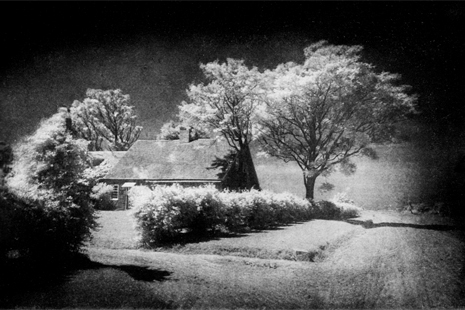
I knew the building was in East Hampton, and I knew the road as it was noted on his letterhead. But try as I might I was unable to pin the building down based on the two photographs I have of it. This one was the one published in the Century Magazine in the Midwinter Number of the Century Illustrated Monthly Magazine, published in February 1910 and was (as far as I know) the first infrared photograph to be published.

From my new contact I now know exactly which house it is. I'm told the building has been modified, which you'd expect after a century or more, but essentially what you can see in this photo (and the one in this earlier blog post) remains the same. The driveway from the road has changed, which is why I couldn't track it down with Google's Street View.

I hope to get a photo of the house as it is now so we can compare. I will let you know.

Friday, 22 July 2022

Infrared Artistry: Re-visualizing Your World with Tony Sweet

On July 30th 2022, at 4 pm UK time, Photographer Tony Sweet will be giving a Zoom presentation on our favourite subject, infrared photography. To quote the blurb ...
Infrared photography is becoming ever more popular. The inherent surreal properties of black-and-white infrared are always surprising and redefine the visual world. This talk will also touch on the world of faux colour infrared. Through ample illustrations, Tony Sweet will breach the curtain between the world we see and the one we imagine in black-and-white infrared and in colour infrared photography. Example images will illustrate the effects of angle and quality of light, times of day, and weather conditions. Questions are encouraged throughout the presentation.
This event is organised by the Digital Imaging Group of the Royal Photographic Society and is free to group members. Other RPS members, and anyone else, pays £3 to access the talk. It takes place using Zoom and everyone is welcome. Here's a link for booking: rps.org/DIGONLINE35/. See you there!

Wednesday, 15 June 2022

The Wood Effect ... on sea

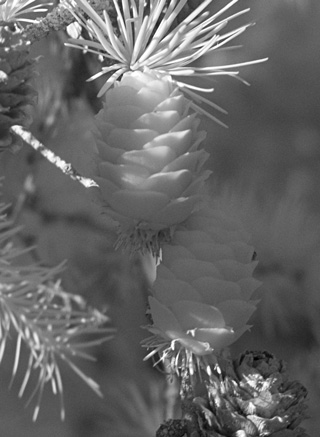
The Wood Effect, whereby foliage shows up 'white' in infrared photographs, is a well-known feature of such images, often mistaken for snow.

Leaves are not the only things to exhibit this, as I found once when photographing young pine cones.

I presume that the young pine cones have an outer layer like a leaf with cells that reflect the infrared light, but this was a bit unexpected.

This next photo shows some seaweed (on the coast of Bardsey Island in North Wales) and this also exhibits the effect.

The black dots in the water are seals by the way.

A final thing that looks different to what you would expect in infrared photography is red wine, which appears transparent. A photo to demonstrate that is for another post sometime. Cheers.

Monday, 16 May 2022

Hello Again

It's been a while since I last posted here. The main reason is that we moved house and then started having 'things' done to the place. Thje good news is that our new location, on the English south coast, has lots of opportunities for infrared shooting ... so more on that as and when.

While you're waiting, please check out the revamped Invisible Light web site, which you can find on a couple of URLs but atsf.co.uk/ilight is the SOA for them all. A lot of the photos from the old site have gone, although eventually most of them will return. At this point There's a small set of galleries for the different techniques together with a bibliography, a list of interesting web sites and a brief history of infrared photography. The techical section is there as well, with some examples of thermal imaging amongst other things. Please check it out.

Incidentally, I've been told that the subscription facility doesn't work. It's probably better to click the Follow link but I have to admit that the intricacies of Blogger are a bit opaque!

Wednesday, 9 February 2022

Paolo Pettigiani

Paolo Pettigiani is a photographer based in Turin. Since 2015 he has beeon working on a project called Infraland, using a full-spectrum converted camera and a 590 nm filter to shoot faux-colour infrared images.

Infraland transforms ordinary places into surreal landscapes unbound by human perception ...

A set of his photographs were published in the Observer newspaper last Sunday (Feb 6th) but you can see his whole project on his web site. With photosets on New York, the Dolomites, Dubai, the Maldives, Alps, Bolivia and Peru. It's a nicely-designed site with some lovely images: well worth a visit.

I am of course rather envious that he managed to get his photographs into the Observer.