Friday, 6 March 2015

Infrared and tissue penetration

A recent article in New Scientist caught my eye. My drug-filled nanospheres heal at the speed of light reports work by a team led by Professor Adah Almutairi at the University of California, San Diego.

Her work explains that by making use of near infrared's ability to penetrate skin and tissue, it is possible to use a laser of the appropriate wavelength to trigger a polymer nanotube to break down and, if it's carrying a drug, to release it. Since the light can be tightly targeted it would be possible to therefore tightly target a release site for the drug. There are other mechanisms for triggering release, such as the temperature of inflammation or even sunlight on the skin. This latter has the neat prospect of a sunscreen that activates when you get into the sun.

While the NS article is very recent, I found a paper from 2011 by Almutairi's team that explains the concept:

Low Power, Biologically Benign NIR Light Triggers Polymer Disassembly Fomina et al
Macromolecules, 2011, 44 (21), pp 8590–8597

You can see the abstract or buy the paper from ACS Publications.

One interesting thing, for me, is the statement at the top of the abstract that "Near infrared (NIR) irradiation can penetrate up to 10cm deep into tissues". Admittedly, from a photographic point of view you need to remember that the IR has to penetrate the tissue and then get back out again, but I believe the figure of 'a few millimetres' has been a good rule of thumb for years. A figure of between one and two cm has been cited from a paper by Gao et al, In vivo cancer targeting and imaging with semiconductor quantum dots from 2004.

So I decided to see what Lou Gibson had to say on the matter in his third edition of Clark 'Photography by Infrared' in 1978. He quotes Balderry and Ewald, in a 1924 paper called 'Life Energy in Theraputics' as saying that sunlight can penetrate up to 25 cm into the body. So that 10cm seems quite reasonable.

Photographically, however, a near infrared photograph will often show veins under the skin, and will almost always give people a 5-o'clock shadow (even some women). This is also, as I've pointed out before, the cause of the alabaster look you can see in infrared portraits. I'll leave you with this image of Jude (a lady with whom I used to work) demonstrating the infrared look, with the added 'bonus' of 35mm infrared film grain.

Tuesday, 3 March 2015

More on visual sensitivity to IR

Following on from the experiment to extend human vision into the near infrared (part of my previous post) I found related papers in the Journal of the Optical Society of America and Acta Physica Polonica.

The first from OSA:

Visual sensitivity of the eye to infrared laser radiation
David H.Sliney, Robert T Wangemann, James K Franks (all U.S. Army Environmental Hygiene Agency, Aberdeen Proving Ground, Maryland) and Myron L Wolbarsht (Duke University Eye Center, Durham, North Carolina)

JOSA, Vol 66, Issue 4, pp. 339-341 (1976)

You can find the paper online (membership/paywall) on the Optics Infobase

The abstract reads:
The foveal sensitivity to several near-infrared laser wavelengths was measured. It was found that the eye could respond to radiation at wavelengths at least as far as 1064 nm. A continuous 1064 nm laser source appeared red, but a 1060 nm pulsed laser source appeared green, which suggests the presence of second harmonic generation in the retina.

Similarly, but more recent and with open access is ...

Perception of the Laser Radiation for the Near Infrared Range
D. Kecika, J. Kasprzaka, (both Department and Ophthalmology Clinic, I Medicine Faculty, Medical University of Warsaw) and A. Zając (Institute of Optoelectronics, Military University of Technology, Warsaw)

ACTA PHYSICA POLONICA A, Vol 120, No 4, pp 686-687

This paper is available as a PDF.

This abstract reads:
During the diagnostic research done by means of optical devices equipped with radiation sources from the near infrared range the phenomena indicating the perception possibility of this range by a human eye were observed. In this contribution the initial results of the research of this phenomenon were presented. Sources of radiation applied in laser polarimeters (785 nm) and devices designed for optical coherent tomography (820, 850 nm) were taken into particular consideration. Perception tests with the use of a laser diode generating at the wavelength of 940 nm were also carried out. It was stated that the radiation from the range examined can be recorded by a human eye giving a colour sensation — in practice independently of the wavelength of the radiation beam falling into a retina.
I suspect this kind of experiment with lasers falls into the don't try this at home category but it demonstrates that the usual limits quoted for human visual sensitivity are not necessarily the only ones.

There's some interesting notes about this also in the Wikipedia entry on light.

The final word may have to go to a paper I found in the Proceedings of the National Academy of Sciences of the United States of America (PNAS vol 111 no 50) with (sorry) too many authors to list (let's just say Palczewska et al) and with the title Human infrared vision is triggered by two-photon chromophore isomerization. Almost totally out of my area of expertise but if you have the knowledge then you can access the paper (paywall) via this link. I'll leave it to the report's authors to have the final word ... quoted from their 'significance'.
This study resolves a long-standing question about the ability of humans to perceive near infrared radiation (IR) and identifies a mechanism driving human IR vision.

Wednesday, 11 February 2015

More snippets

Apologies for not posting yet this year ... but here are a few items to make up for it.

Towards the end of last year I came across a claim that a special diet could extend human vision into the edge of the near infrared.

Petapixel carried an explanation of the research project and also a rebuttal by a neuroscientist. The original crowd-funded experiment page is on experiment.com and the group carrying out the research is called Science for the Masses. Since last August the web seems to have gone quiet on the project.

A slight increase in deep red sensitivity would be useful for astronomers wanting to view the universe at the wavelength of hydrogen-alpha: 656.28 nm. Canon produced a camera modified to give similar better response a few years back and Nikon have now also done so, although theirs is a high-resolution full-frame camera. It's the D810A. The older Canon still had some infrared filtering in place so it couldn't be used for infrared photography, but it is unclear whether this is the case with the Nikon. The press release is unclear although DP Review suggests that there is still filtering.

For those of you interested in the BBC's natural history infrared shooting, there is a training film on line where Colin Jackson explains his technique. However, this his team moved on to using modified Canon DSLR cameras rather than 'pure' video cameras so the film is a little out of date.

Finally, a thermal imaging video showing cloud formations across the earth, shot from space at a wavelength of 6.5 µm. (This is worth expanding for a better view.)


Thursday, 4 December 2014

RPS Journal article on creative thermal imaging

I've mentioned Joseph Giacomin's artistic thermal images in previous posts. This is a rare art, not least because the cameras are either very expensive or of low resolution (or sometimes both).

Members of the Royal Photographic Society can get a background briefing from him in the latest edition of The Journal, entitled Heat and Light (page 802). It's clear explanation of the principles of thermography and well worth a read.

Wednesday, 12 November 2014

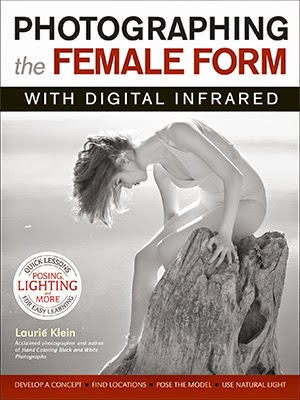
Photographing the Female Form with Digital Infrared

It's been a while since Amherst Media published a slew of infrared photography books, including Joe Paduano's seminal The Art of Infrared Photography. Those are still in their catalogue, now joined by a fascinating book from Laurie Klein [Laurie's web site] with one of those 'exactly what it says on the tin' titles.

Photographing the Female Form with Digital Infrared

Near infrared light penetrates skin to a depth of a few millimetres. This tends to give skin a milky appearance as you're not seeing the surface (some moral there perhaps) but can also show up veins and make some marks, especially tattoos, stand out starkly. There can also be a spooky effect on eyes, making them look like dark pools. So combining infrared photography and skin can be 'interesting'.

Laurie Klein studied with Ansel Adams and spent some of her professional life as a landscape photographer, moving on to people and weddings. Her approach to people photography brings an appreciation of landscape; both the person in the landscape and the person as landscape. Almost all the images in the book are taken with a modified DSLR and shown in black and white. There is one example of 'good old' HIE 35mm film, which doesn't stand out as being that different from the digital shots, and one faux-colour shot ... of a woman in a wine-dark river ... which definitely benefits from the splash of colour. The models are all (or look to be) white; so my only wish would be to have seen what Laurie could do with darker skin tones. Having said that, the tonal differences at infrared wavelengths are not as pronounced as they are in visible light. In Laurie's photos, one interesting effect of the infrared is that the models' nipples render white as well. It's a very alabaster and sculptural look.

Incidentally I am impressed with the quality of the printing. In the past I have sometimes found Amherst's infrared images to be over-contrasty, but not here.

Alongside the photographs, Laurie explains how and why she posed the models as she did, and includes alternative 'takes' from the session. The train of thought is interesting, sometimes making me see the landscape photographer within being able to move those mountains to get the shot required. Here are nudes, props and landscape ... especially rocks and foliage ... arranged to taste.

As I said, it's a fascinating book, with lessons for all photographers and for any subject, and Laurie exploits the artistic possibilities of infrared light brilliantly.

[$27.95, 7.5x10 inches, 128 pages 180 photographs
ISBN-13: 978-1-60895-719-4]